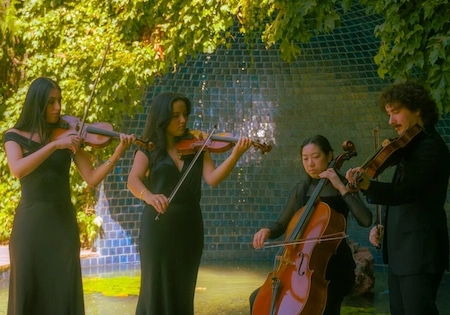
Edmund Mantelli & Cedar Quartet

EVENT DETAILS
Solo Viola and String Quartet Recital
J.S. Bach, Suite No. 2 for Solo Cello (arr. viola)
Bach’s six suites, originally for cello, are exponentially legendary. They are beautiful melodies and dances with timelessly expressive harmony, a perfect staple in any musician’s repertoire.
I love the second suite for how directly it conveys these qualities - a theme unapologetically spelling out each chord in the harmony, followed by dance, after dance, after dance.
Bach’s solo suites, sonatas and partitas are the blueprint for a single string instrument delivering a harmonically rich and complete performance.
Paul Hindemith, Sonata for Solo Viola, Op. 25 No. 1
The 1937 sonata was written on a train journey from New York to Chicago, and was apparently performed a few days later.
The first movement is a bold declaration overtaken with nervous unsettled harmony and energy. The second is lyrical, gruff and scattery, each at different moments - an explorative contemplation. The sonata concludes with quite a militaristic theme, soon divulged into further uncertainty.
“He is unwilling to exploit his feelings publicly and he keeps his two feet on the ground.” Albert Einstein about Hindemith.
- INTERVAL -
Joseph Haydn, String Quartet Op. 76 No. 4 “Sunrise”, II. Adagio
From 1937, back 140 years to 1797. Haydn String Quartets are another staple of any musician’s repertoire. They are beautifully written with sophisticated harmonic eloquence, presenting the perfect canvas to paint a unified quartet sound.
Haydn’s “Sunrise” quartet is aptly named for its shining sunrise theme in the first movement. Today we present only the second movement, which is one of the most poignantly joyful pieces of music. The atmosphere has a sense of warmth amongst the cold, the signs of early light, beginning to brighten the dead of night.
Paul Stanhope, Dancing with Strangers
This piece is named after a historical book of the same name depicting the first contact between the Gadigal people and the First Fleet of British colonisers as they arrived in the area they renamed “Port Jackson”. The work was commissioned for an Australian Youth Orchestra program.
You can hear elements of military, native bird noises, dance, ceremony, and chaos. The use of extended techniques is masterful, offering percussive depth and sonic intrigue. The lush Sereno section in the middle is quite grounding as it is almost jarring to hear such beautiful, rich harmony amongst the excitement and eventual chaos. It is quite a powerful and exciting piece, offering much to reflect upon.
Program notes, written by Edmund Mantelli.